
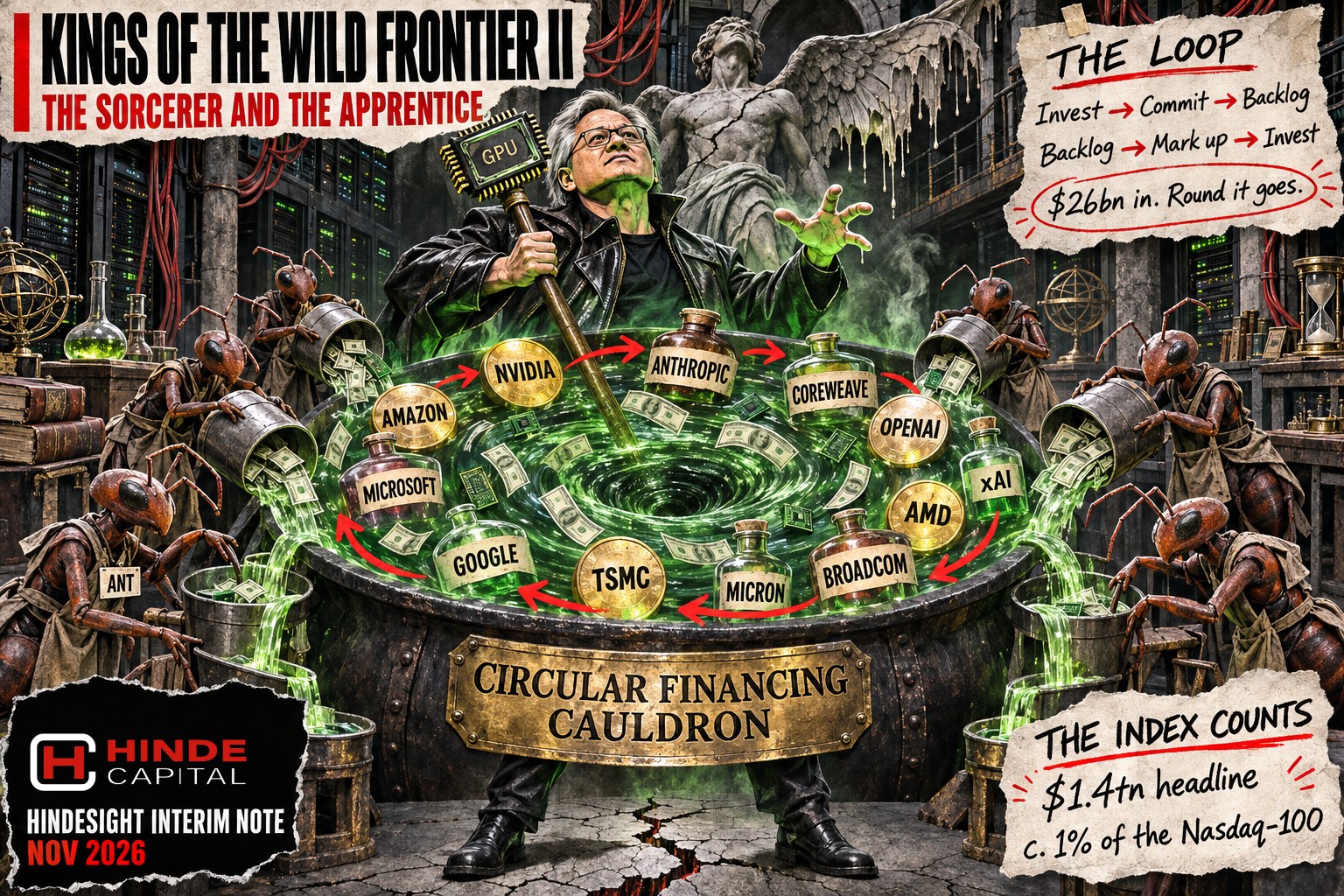
NVIDIA has lost close to $2 trillion since its October high as reports of Jensen Huang’s affairs, one with an alleged Chinese spy tied to the chip buyer Megaspeed, push its board towards removing him.
The scandal is the tip of the ‘chipberg’. The larger question is who was really buying the chips, and whether a short-seller analyst firm is right that diverted Chinese demand still drives NVIDIA’s sales.
Anthropic lists on 19 November at a headline valuation of up to $1.4 trillion, but the Nasdaq-100 will initially count only about $193bn of it, a weight of around 1%.
SpaceX joined the index at a 1.28% weight in July and was at 2.82% by September, because more of its shares became free to trade and index funds had to buy more. Anthropic could follow the same path. The index buying can be predicted. How much stock insiders sell into it cannot, and that decides the price.
NVIDIA and six other suppliers are putting $26bn into Anthropic alongside the IPO. The demand is real, but it is not independent of the financing.
The bounce in markets lacks breadth, leadership and credit confirmation. The major correction is not over.
Contents
Icarus In A Leather Jacket
NVIDIA closed at a record $239.24 on 6 Oct 2026. It was indicated near $159 on Wednesday night, a third lower, with about $1.9 trillion of market value gone. The frontier has a habit of doing this to its kings.
The facts, as reported, are these. On 6 Nov the New York Times reported that Jensen Huang had a relationship with Alice Huang, no relation, an executive at the Singapore chip buyer Megaspeed whom US intelligence believes to be a Chinese spy.3 On 8 Nov Mr Huang admitted an affair in an email to staff and the board opened an independent investigation, with Wachtell Lipton retained.2
On 11 Nov the Times reported a second alleged affair, this time with an NVIDIA executive who reports to him. The Wall Street Journal then reported that the board was preparing to remove him.4 Directors met late on Wednesday. No decision had been announced by Thursday morning.6
China calls the spy allegation baseless.5 The board has said it has no reason to believe that national security or company secrets were compromised. Congress is threatening a subpoena, shareholders have sued and results are due on 17 Nov.
Whether this was a honey trap is a matter for the investigators. HindeSight is not here to trade in salacious gossip. The affair matters for what it exposes.
Figure 1 · The Sorcerer Of Silicon
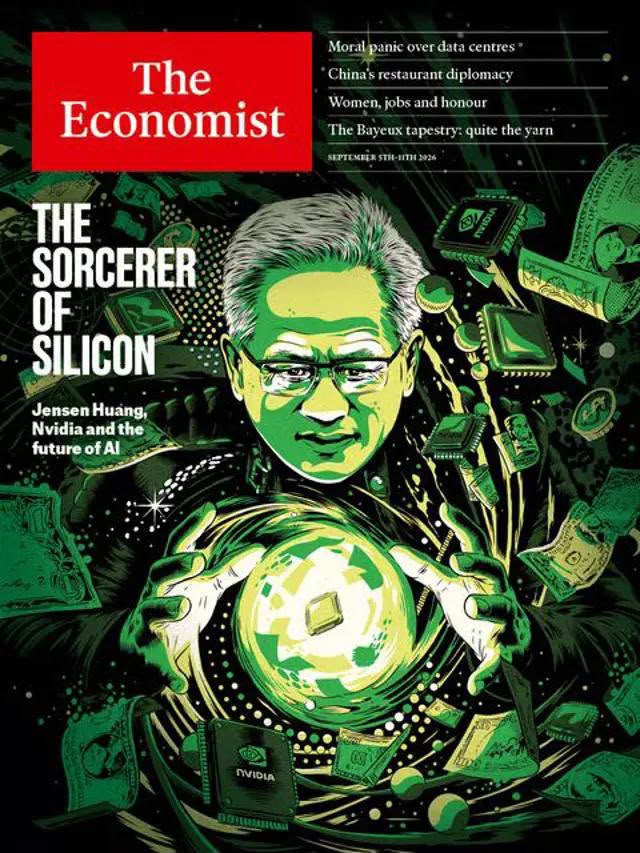
The Economist put Mr Huang on its cover for the week of 5 Sep 20261, a sorcerer conjuring chips and dollar bills from a crystal ball. The shares made their record close a month later. They have fallen by a third since.
The magazine cover indicator is an old market superstition with an awkward record of being right. When a general-interest weekly crowns a man the wizard of his age, the story is already in the price and usually a little more besides. Icarus flew too high and all that.
The Economist did not sink NVIDIA. It merely told us the last buyer had arrived. Consensus that complete rarely unwinds politely.
The Tip Of The Chipberg
The personal scandal is what shows above the water line. The larger mass below it is the question of who has really been buying the chips and was it fraudulent and in breach of US trade policy.
Megaspeed, a former gaming company based in Singapore, has bought nearly $5bn of NVIDIA chips and hardware in three years, according to the New York Times. Investigators say Alice Huang used industry contacts and a series of shell companies to gain access to 240,000 chips banned for export to China. Megaspeed is reported to be under investigation by the US Commerce Department and by the Singapore authorities.7
None of this was hidden. On 13 May 2026 the short seller Culper Research published a 40-page report that called the two Huangs “uncomfortably close”.8 Culper alleged that more than 20% of NVIDIA’s fiscal 2026 compute revenue was still driven by Chinese demand, routed through diversion and South-East Asian intermediaries. NVIDIA has said its China compute business went to zero after the April 2025 export restrictions.9
These remain allegations from a firm that profits if the shares fall. But if the diversion claim is even partly right, a meaningful share of reported demand was demand the export rules forbade. That is a revenue question, a legal question and a political one.
Culper also put a number on it. On its bottom-up estimate, more than $30bn of fiscal 2027 revenue rests on that exposure, which it says the consensus is not pricing. Note what it does not allege, namely that NVIDIA’s revenue recognition breaks US accounting rules.10
The market ignored Culper for six months. Why it all surfaces now, days before results and a week before a blockbuster $64bn AI listing that NVIDIA supplies, we will no doubt find out.
The question left unanswered, for now, is whether there are any accounting irregularities or an overstatement of sales.
Not Gossip
Nobody should underestimate what Jensen Huang leaving would mean. He founded the company in 1993 and has run it ever since. The market is beginning to price NVIDIA without him as the likely outcome.
Even if he stays, the scrutiny does not leave with the headlines. A board that has hired outside counsel to examine its chief executive will examine what he signed. That includes the commitments NVIDIA has made to finance its own customers.
NVIDIA is one of seven suppliers in Anthropic’s $26bn private placement, down for about $10bn at the filing’s midpoint price.11 The commitment is conditional on the IPO completing. It was made by a company worth close to $2 trillion more than it is today.
Supplier financing to date has rested on three things, a share price that makes the cheque look small change, a chief executive with the authority to write it, and a board, judging by their skillsets, that does not ask too many questions and is riding the bull. All three are now in doubt at once.
Whether those commitments remain firm is the question that matters. It is why this note sits in front of six charts on Anthropic, SpaceX and the passive bid. The Kings of the Wild Frontier just got wilder, you literally could not make this up, oh wait...
IPO Index Inclusion And The Ties That Bind
NVIDIA has surrendered approximately $1.6 trillion of market capitalisation since its October peak, approaching $2 trillion at the indicated overnight price. Now into that vacuum comes Anthropic, preparing a Nasdaq listing at a potential headline fully diluted valuation of up to $1.4 trillion.
It is tempting to describe one as replacing the other. That, of course, would be misleading. Market capitalisation is not capital entering or leaving the market. Nor does Anthropic’s headline valuation determine how much of the company the Nasdaq-100 initially recognises for index weighting.
The anticipated IPO creates something more interesting than a transfer of market value, rather a sequence of predictable index-related transactions, potentially repeated as more shares become freely tradable.
Note the timing too. ANT is due to list on 19 November, two days after NVIDIA reports earnings. If the results bring a sigh of relief, Anthropic may premiere on the Nasdaq in rather more benign conditions than this week’s. If they do not, the debut likely inherits the damage unfolding.
SpaceX provides a recent precedent. Its reported Nasdaq-100 weight rose from 1.28% at entry in July to 2.82% at September’s rebalance,14 despite little change in its assumed total market capitalisation.
The mechanism is straightforward but its market consequences are less so. A release of restricted stock creates potential selling supply. When Nasdaq recognises the increased float, it may raise the stock’s index weight, requiring benchmark trackers to increase their exposure. 'Arbitrageurs’ (less arb, more opportunists) can anticipate both events.
The release creates potential supply and immediate recognition of this creates mechanical demand. Arbitrageurs trade the interval in between timings on this, with price the ultimate arbiter of who wins.
For the wider Nasdaq-100, however, rebalancing is principally a redistribution of existing capital, not the creation of new capital. Buying Anthropic generally requires a fully invested index fund to sell something else, i.e. rebalance its portfolio.
And in this instance, much of what may be sold is exposed to precisely the same AI investment cycle.
Figure 2 · The Forced-Buying Window
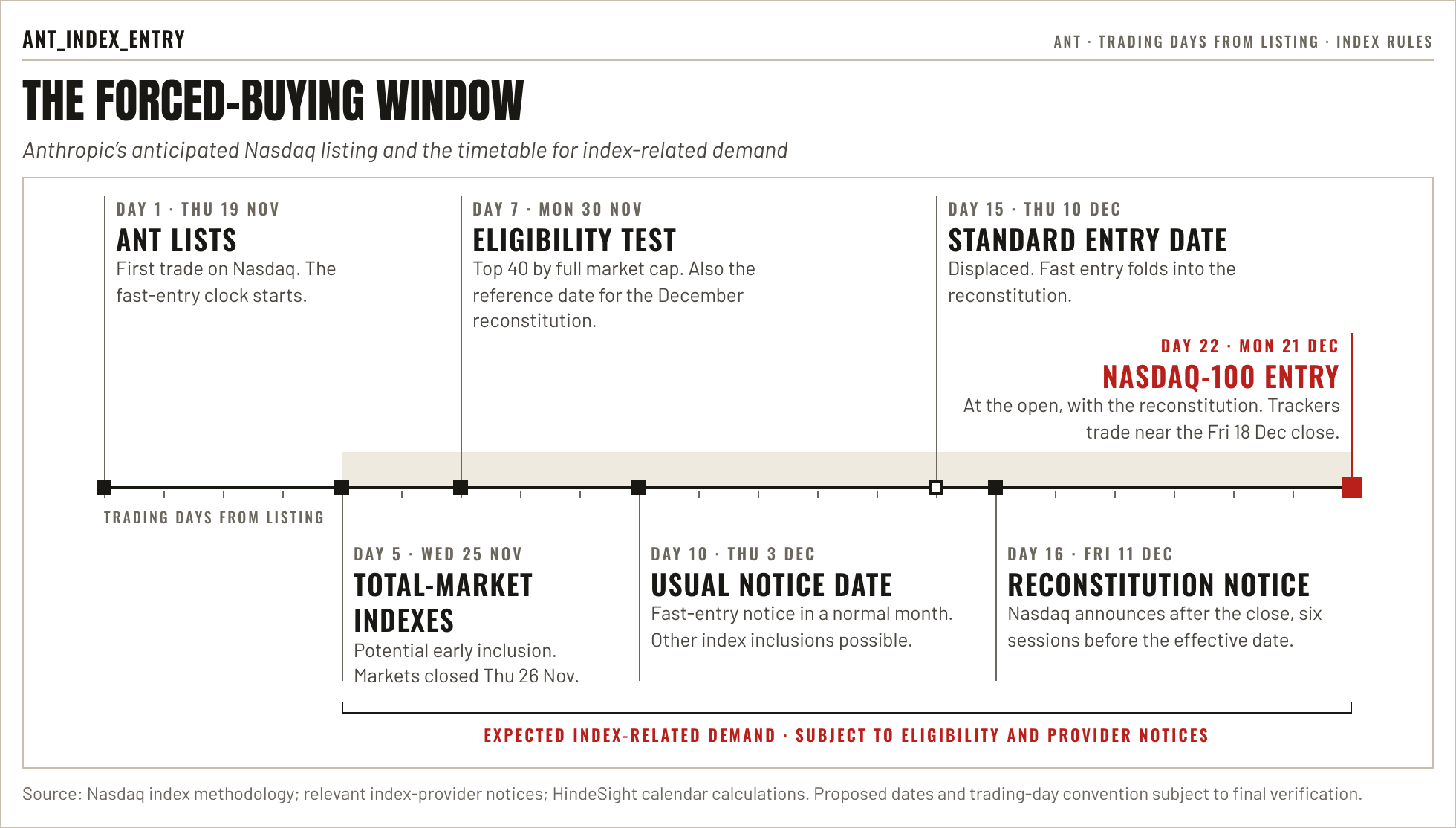
Anthropic’s proposed 19 November listing could open a concentrated window of benchmark-related buying, beginning with eligible total-market indices and potentially culminating in Nasdaq-100 inclusion at December’s reconstitution.
The provisional timeline places the earliest index additions around 25 November. Nasdaq-100 inclusion would ordinarily follow after fifteen trading sessions, on 10 December, but December’s scheduled reconstitution moves it to the open on 21 December, subject to provider notices.12
Note these are new rules. Nasdaq rewrote its methodology in March, effective 1 May 2026, to fast-track the new darlings into the index, after SpaceX made early inclusion a condition of listing there.13 Until then a new listing waited at least three months, and often until the December reconstitution.12
The initial allocation of shares does not mean all index demand will arrive in the same session. Arbitrageurs and discretionary investors may accumulate shares ahead of the effective dates, anticipating purchases by funds required to track the revised benchmarks.
That distinction matters. A predictable buyer can be anticipated. The stock may rise before inclusion and fall during the very session when passive funds are buying, if the earlier buyers use the closing auction to distribute their holdings.
The passive bid is genuine though its price impact depends on how much has already been anticipated and how much stock shareholders are willing to sell into it.
Figure 3 · What The Index Counts
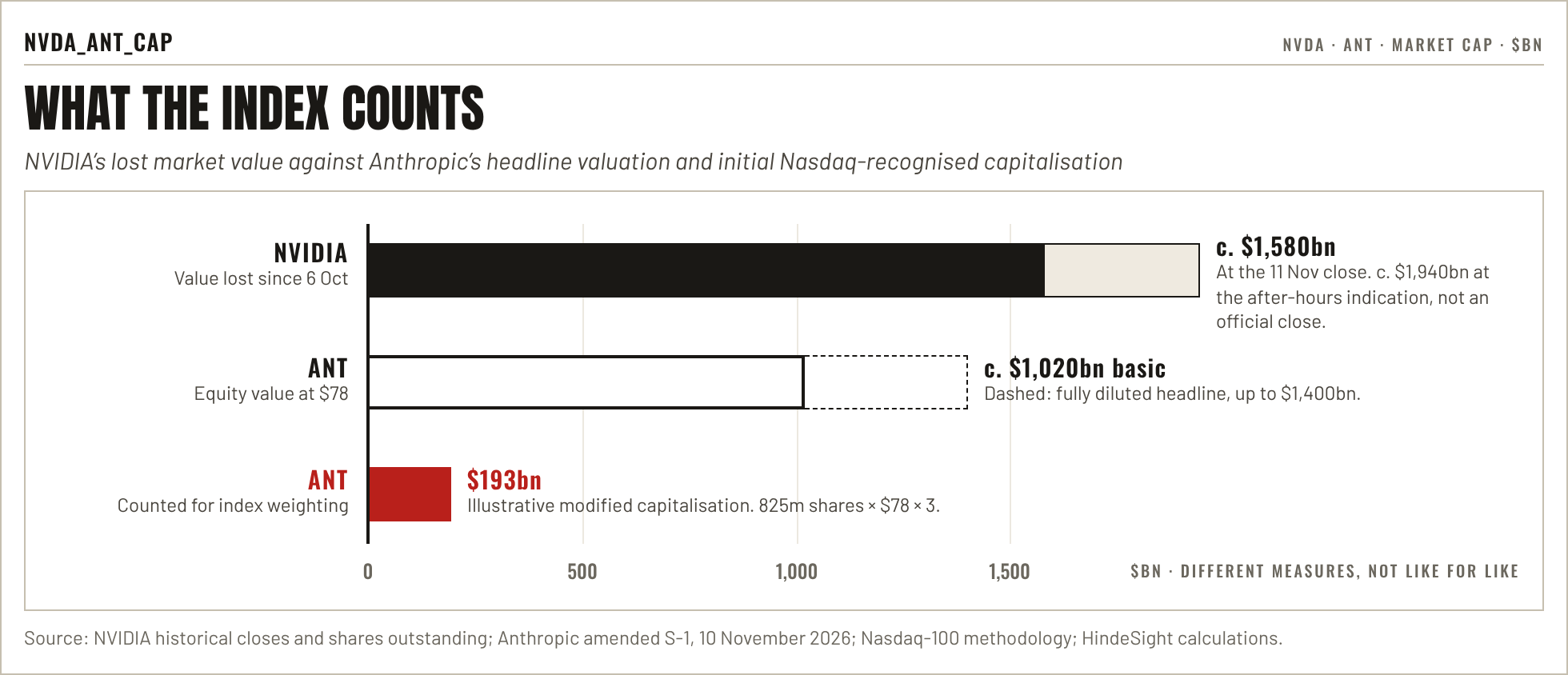
At its 11 November close, NVIDIA had lost approximately $1.58 trillion of market value from its 6 October high. At the indicated after-hours price, the decline approached $1.94 trillion.
Anthropic arrives with a prospective headline fully diluted valuation of up to $1.4 trillion. That is not an equivalent addition to the Nasdaq-100.
At the assumed $78 offering price, its 825 million publicly offered shares represent approximately $64bn of stock.11 Applying Nasdaq’s three-times-float adjustment produces an illustrative modified capitalisation of approximately $193bn, before the remaining index weighting adjustments.
This is only about 12% of NVIDIA’s $1.58 trillion decline, although the two figures are deliberately different measures... NVIDIA’s lost full equity capitalisation against the portion of ANT’s value initially recognised for index weighting.
Nor should the comparison be read as money leaving NVIDIA and entering Anthropic. A fall in market capitalisation is a repricing of outstanding shares, not a corresponding withdrawal of cash.
The more useful observation is that NVIDIA’s weight has declined with its share price, while Anthropic’s arrival introduces another company whose economics depend on the AI investment cycle.
Single-stock concentration may have declined. Concentration in the underlying economic theme has not necessarily done so.
Figure 4 · A Trillion Dollars, One Per Cent
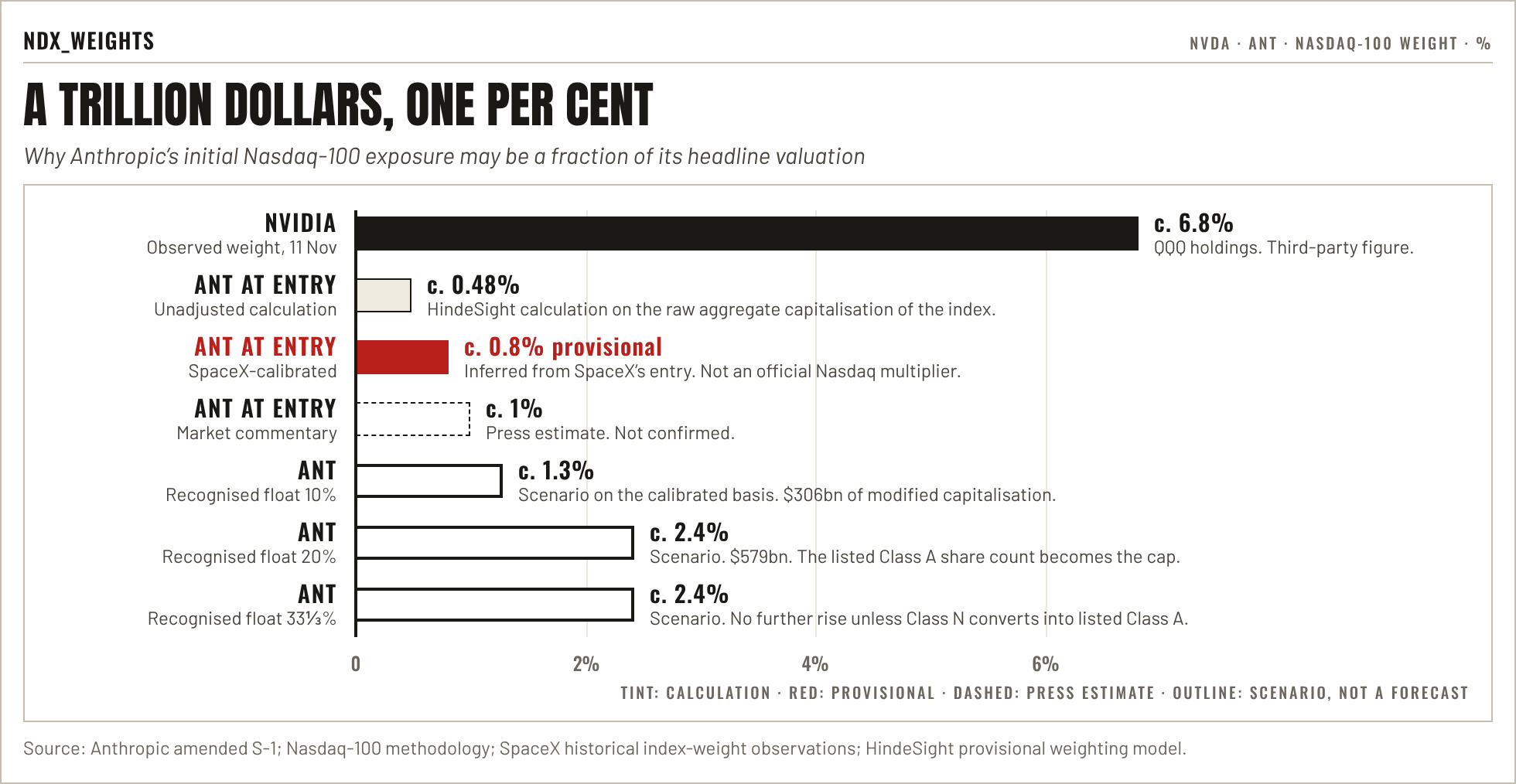
The distinction between valuation and index weight becomes clearer when expressed in percentages.
NVIDIA’s observed Nasdaq-100 weight was approximately 6.8% in November.16 Anthropic’s initial weight is provisionally estimated at around 0.8%, potentially close to 1%, subject to Nasdaq’s actual constituent-weight calculation.
At $78 a share and assuming the 825 million IPO shares form the recognised initial float, the index’s low-float methodology produces approximately $193bn of modified capitalisation.
An unadjusted calculation gives a weight of approximately 0.48% using the workbook’s raw aggregate capitalisation denominator. A SpaceX-calibrated calculation suggests approximately 0.8%, although the inferred weighting adjustment is not an official Nasdaq multiplier.
The difference is material. Using $1.4 trillion of index-tracking assets, the modelled target holding would be approximately $6.7bn at 0.48%, or $11.2bn at 0.8%. Neither amount should be described as entirely incremental purchasing without allowing for existing holdings, anticipatory trading and portfolio implementation.
There may be subsequent increases in ANT’s weighting as more shares become eligible for trading and Nasdaq recognises changes in free float.
But the weight does not automatically increase every time a contractual lock-up expires. The index provider must recognise the change, and its methodology determines when the revised weighting takes effect.
The initial inclusion may therefore be the first stage of a longer adjustment process, not a single event.
Figure 5 · From A Seventh To The Whole
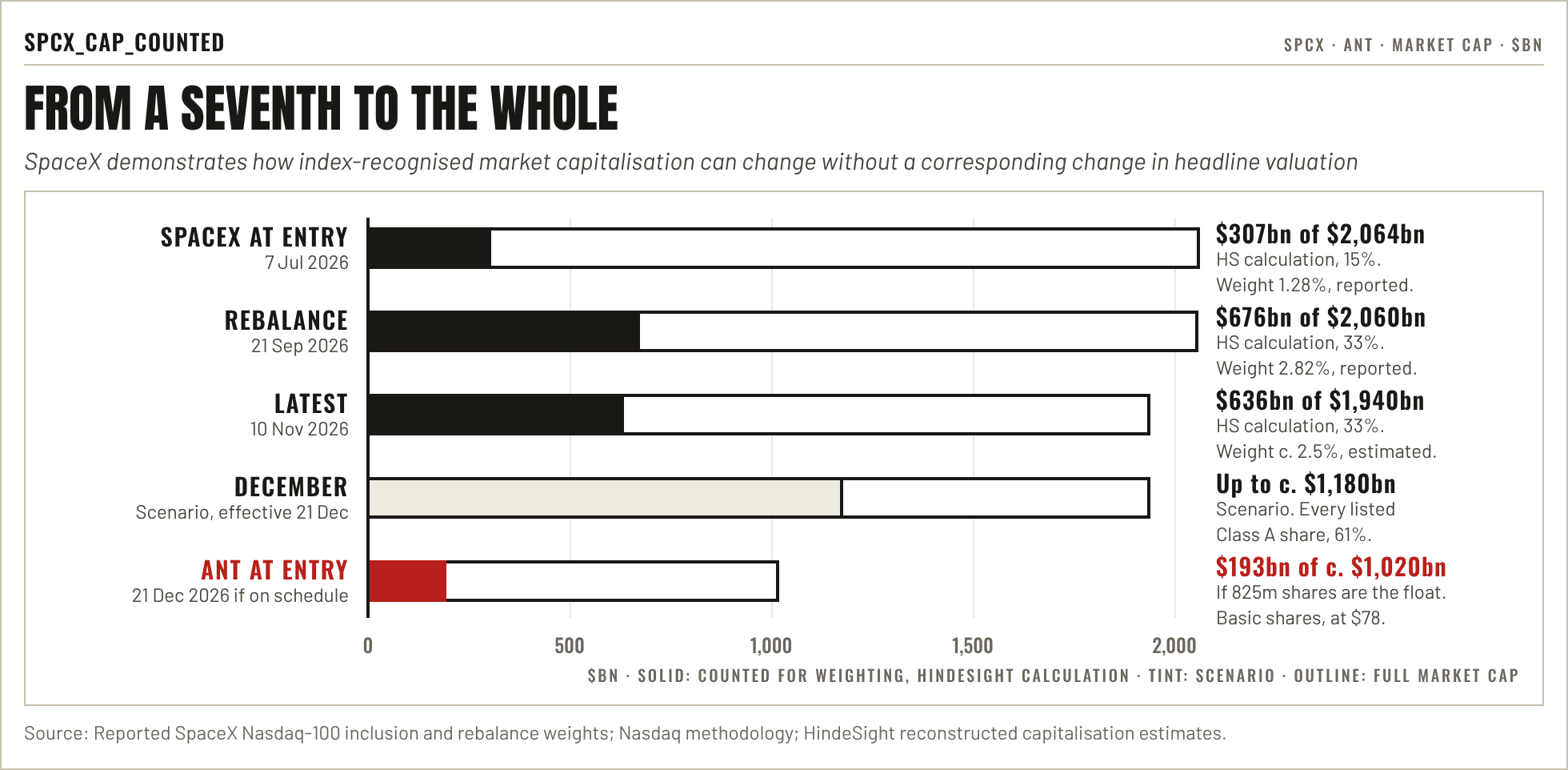
SpaceX entered the Nasdaq-100 in July 2026 with a reported 1.28% weighting. By the September rebalance, that weight had risen to 2.82%14, despite its assumed market capitalisation remaining close to $2.1 trillion.
The chart illustrates how changes in the shares recognised for weighting can generate successive increases in a company’s index exposure.
At entry, the reconstructed model puts SpaceX’s recognised capitalisation at approximately $307bn, around 15% of its assumed full value. By September, the model puts it at approximately $676bn, close to one-third.
Those dollar figures are HindeSight reconstructions, not independently reported Nasdaq capitalisations. The observed weights are the stronger evidence.
The important point is that a company’s index exposure can rise substantially without a corresponding increase in its market value. A higher recognised float changes the index maths and the number of shares benchmark trackers seek to hold.
But recognising more shares does not make them more valuable. Indeed, the event that increases index demand may also release substantial quantities of stock previously unavailable for sale.
The chart should therefore be read as a history of changing benchmark exposure, not a history of guaranteed price support.
Figure 6 · The Passive Staircase
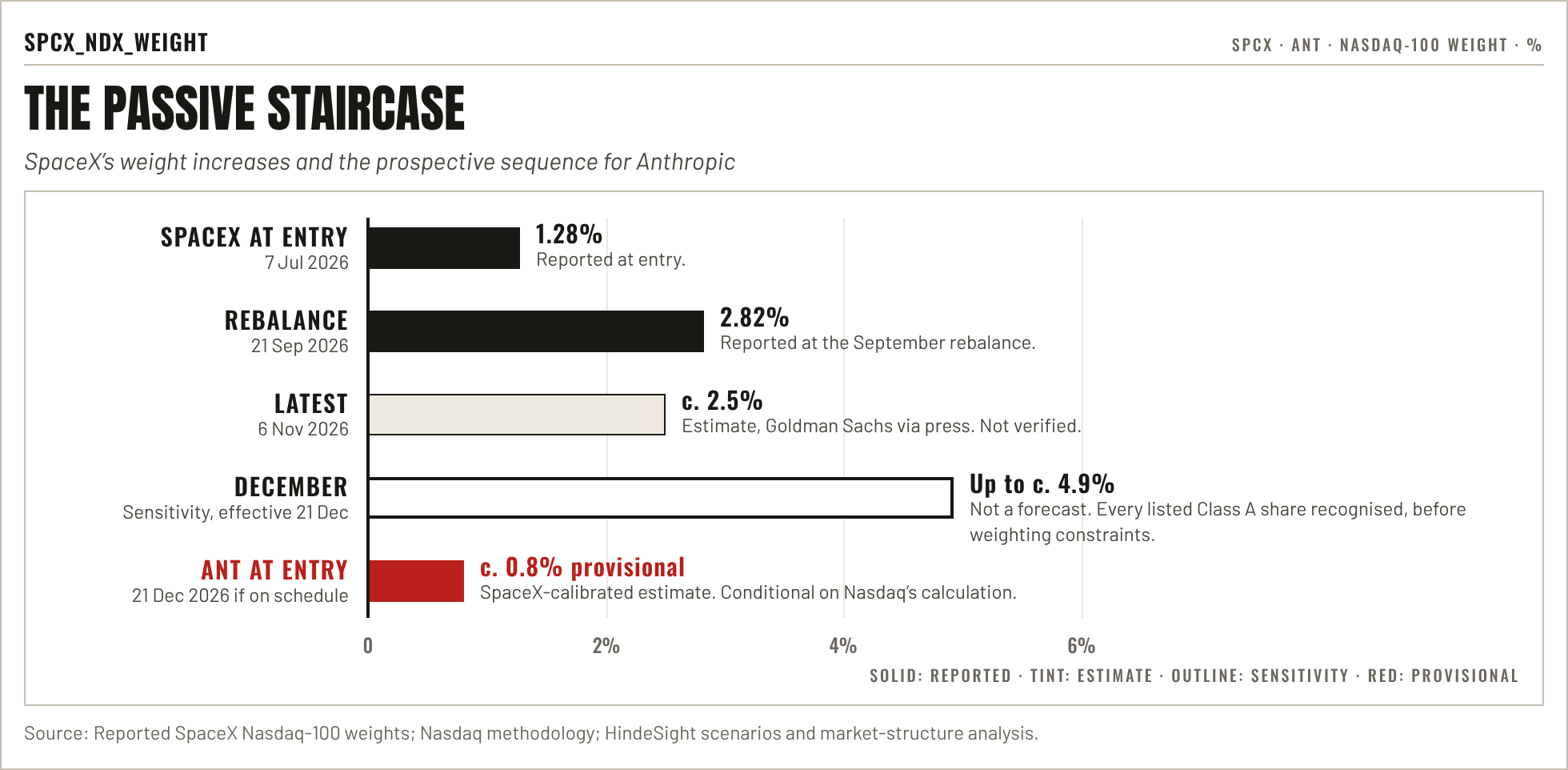
The SpaceX precedent gives the mechanism a timetable.
Its reported Nasdaq-100 weight rose from 1.28% in July to 2.82% at the September rebalance. The November estimate is approximately 2.5%.15 Any projected December increase remains a scenario, not an announced index weight.
What matters is the sequence. The initial listing established a small recognised float and a corresponding index weight. Subsequent changes in eligible supply altered the index calculation, creating fresh benchmark-related demand when the revised weights were implemented.
Anthropic may follow a similar path, although its share-class structure, placement restrictions and precise Nasdaq treatment differ.
This produces a particular market structure. Shareholder restrictions can expire before the index formally recognises the resulting increase in float. The delay creates an interval in which discretionary investors and arbitrageurs can trade the anticipated balance between selling and subsequent benchmark purchases.
Some may short the stock ahead of a large release if they expect substantial insider selling. Others may accumulate shares ahead of the index rebalance, anticipating a price-insensitive buyer at the effective close.
The same participant can operate on both sides of the sequence. But these are trading opportunities, not a mechanical route to profits. The supply is potential, the benchmark demand is conditional on the index adjustment, and the clearing price remains uncertain.
The passive staircase can produce repeated buying windows. It cannot guarantee that the share price climbs with them.
Figure 7 · The Customer Finances Its Suppliers. The Suppliers Finance The Customer.
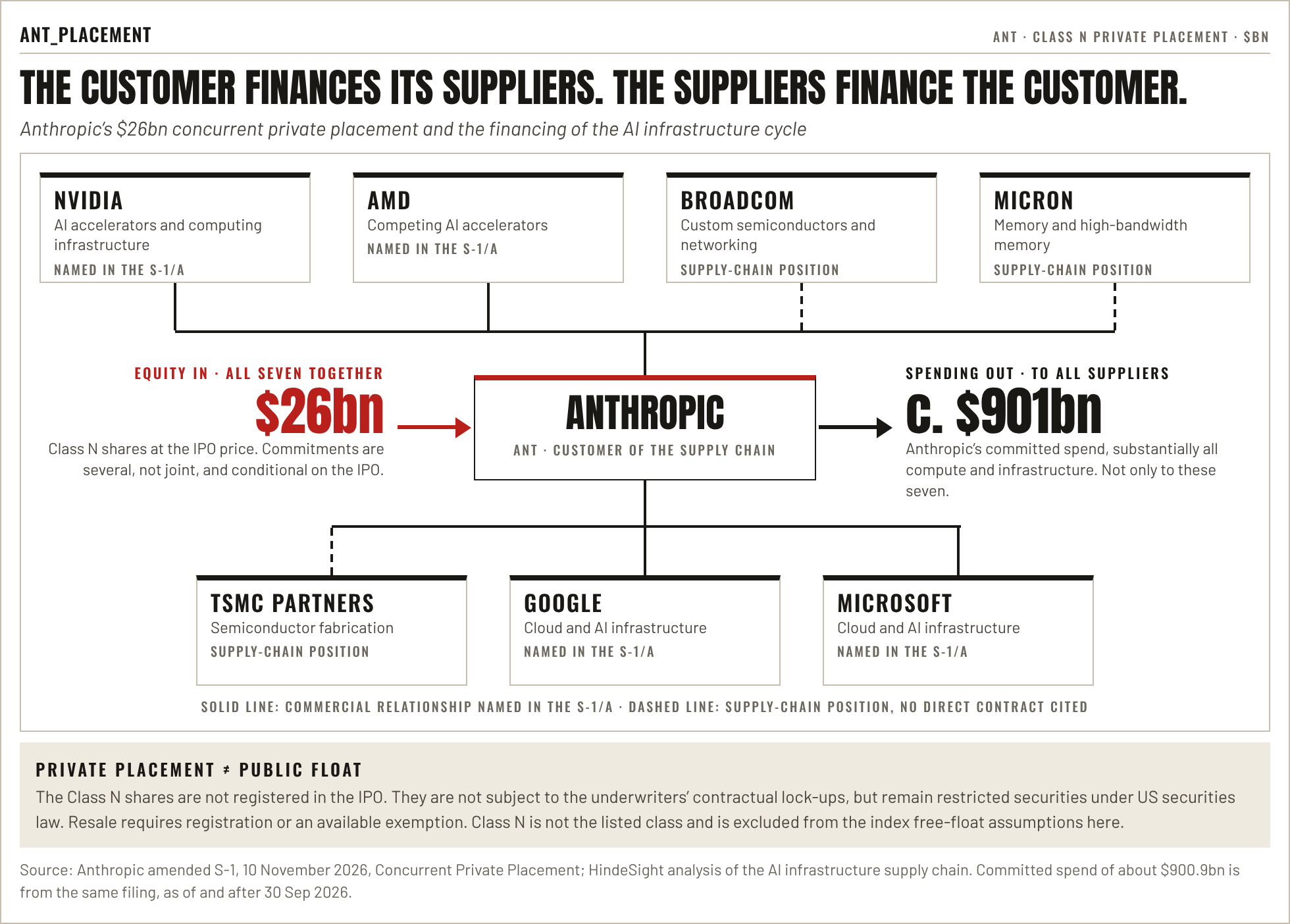
Alongside its IPO, Anthropic has arranged a $26bn private placement with seven companies at the heart of the AI infrastructure supply chain: NVIDIA, AMD, Broadcom, Micron, TSMC Partners, Google and Microsoft.11
These are not simply financial investors. Collectively, they participate in the design, manufacture, provision and operation of the infrastructure required to train and deploy artificial intelligence.
Their investments are genuine equity subscriptions, not loans or contractual guarantees. The Class N shares are restricted securities and must not automatically be treated as freely tradable IPO stock.
There is also an important distinction within the $26bn. Google is funding part of previously committed investment obligations through the placement. The entire amount should therefore not be described as necessarily incremental capital beyond earlier commitments.
The significance lies in the relationship between supplier and customer.
The suppliers are paid for the chips, memory and computing infrastructure being built. Some of those same companies are investing in a developer whose future expenditure is expected to sustain demand for that infrastructure.
This does not establish that the commercial demand is artificial, nor does it mean the suppliers’ revenues are fictitious. The equipment is real, the contracts may be enforceable and the customer may ultimately earn extraordinary returns.
But it introduces a reflexive element into the financing. The capital invested in the customer helps support the customer’s ability to spend, while the spending contributes to the suppliers’ earnings and valuations.
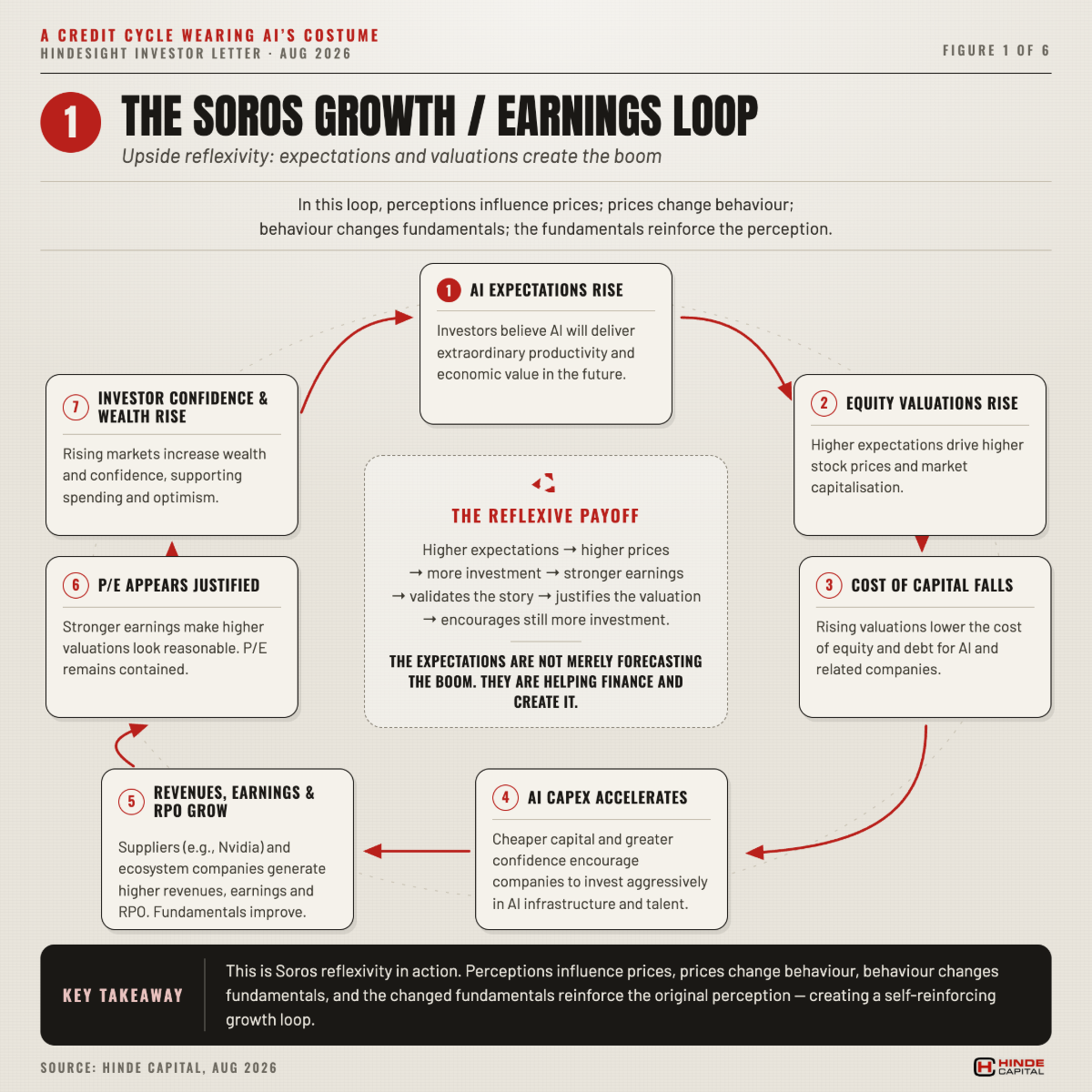
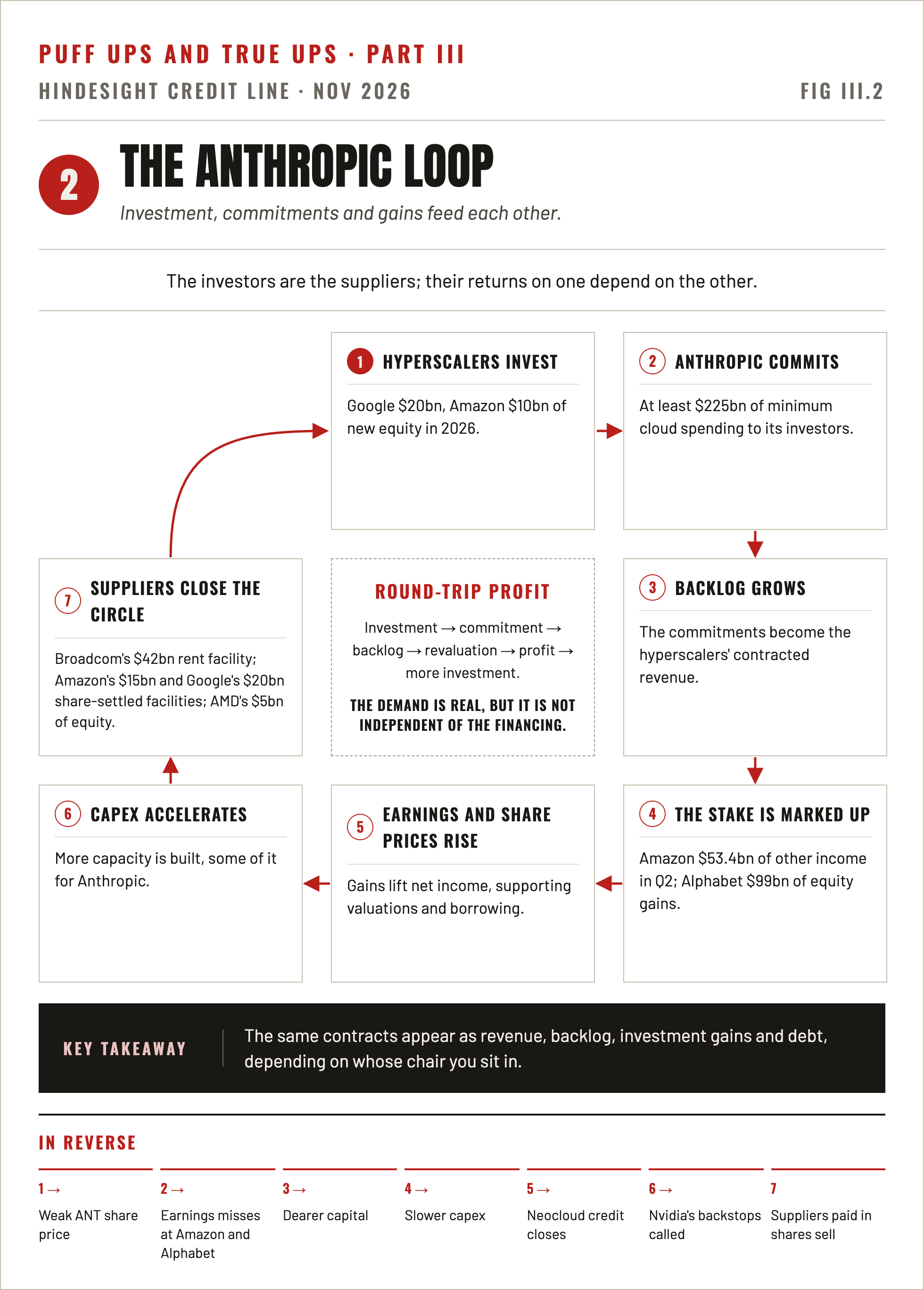
The question is how much of the final demand is independently financed by profitable use of AI, and how much still depends on capital flowing through the companies participating in the build.
The Passive Bid And The AI Credit Cycle
The six charts describe two different processes which markets have become accustomed to treating as one.
The first is mechanical. Index providers determine eligibility and weightings. Benchmark funds adjust their holdings. Arbitrageurs anticipate the changes. Shares move between investors, sometimes in very large quantities, over relatively compressed periods.
The second is economic. Companies commit capital to build computing infrastructure, suppliers earn revenue from delivering it, and the eventual users must generate sufficient income or savings to justify the expenditure.
The first process can support the price of a share for a period. It cannot establish the economic return on the capital represented by that share.
SpaceX shows how successive increases in recognised float can create repeated periods of benchmark demand. Anthropic may follow a similar path, beginning with its IPO and continuing through future changes in its tradable share base.
But a Nasdaq-100 index rebalance is principally a reallocation within an existing portfolio. Additional ANT purchases must generally be financed by reducing holdings elsewhere in the index.
Nor is the balance between supply and demand predetermined. A lock-up expiry introduces stock that existing shareholders may wish to sell. A subsequent change in index weighting introduces a buyer with relatively little discretion over the quantity required. Arbitrageurs trade the anticipated difference.
There is no contradiction in the stock falling while the passive funds buy. The marginal seller may simply have more shares to dispose of than the index buyer requires, or earlier investors may already have accumulated stock in anticipation of that demand. Or the clearing price is lower as overall indices fall.
Which returns us to NVIDIA.
Its decline has reduced the weight of one exceptionally large company in the Nasdaq-100. Anthropic’s prospective inclusion does not reverse that decline or restore the capitalisation that has disappeared.
Instead, it potentially adds another large company whose revenues, spending commitments and financing relationships are tied to the same AI infrastructure cycle.
And the $26bn concurrent placement sharpens that observation frankly. The companies supplying the infrastructure are helping finance one of the customers expected to consume it.
The circularity is economic. Genuine sales and genuine investments can form a mutually reinforcing system in which capital availability sustains expenditure, expenditure sustains earnings, and earnings support the valuations that make further capital available.
George Soros would recognise the reflexivity. Hyman Minsky would ask what happens when the financing slows.
That is the connection between these charts and the October HindeSight series, The AI Catch-22.
The technology may fulfil its promise. The suppliers may continue to earn substantial profits. Anthropic may become one of the world’s most valuable companies.
None of those outcomes guarantees that every dollar committed to the infrastructure will earn an adequate return. There are therefore two distinct questions.
The market-structure question: At what price does newly available shareholder supply clear against anticipated benchmark demand?
The economic question: Once the capital raising, index buying and supplier financing have passed through the system, what independent cash flow supports the valuations?
The first determines the trade around the listing and subsequent rebalances. The second determines the investment.
The release creates potential supply. And passive fund recognition creates mechanical demand. Arbitrageurs trade the middle, the timing interval. And of course price decides who wins at what value.
But the capital cycle ultimately decides who gets paid, and with this debacle at NVIDIA, market participants are to my mind far too complacent on how integral NVIDIA has been to this stock market swoon and GDP gains in the US and rest of the world.
Market Observations From This Week And Last
A sleeper rally followed the rapid reclaim of 7500 on the S&P. It was a classic negative gamma and short-covering squeeze, with a clutch of global indices retesting their breakdown levels. For a bear this is the place to look for failure and another leg down. If it does not fail, get out of the way.
The tell was NVIDIA. The leader was hit hard on the Jensen drama and the shipment questions, yet the broader market refused to follow. Other semis and DRAM names ripped while money rotated into discretionary and staples. If a market cannot go down on real bad news for its leader, positioning and exhaustion matter more than the headlines.
Figure 8 · NVDA_4H
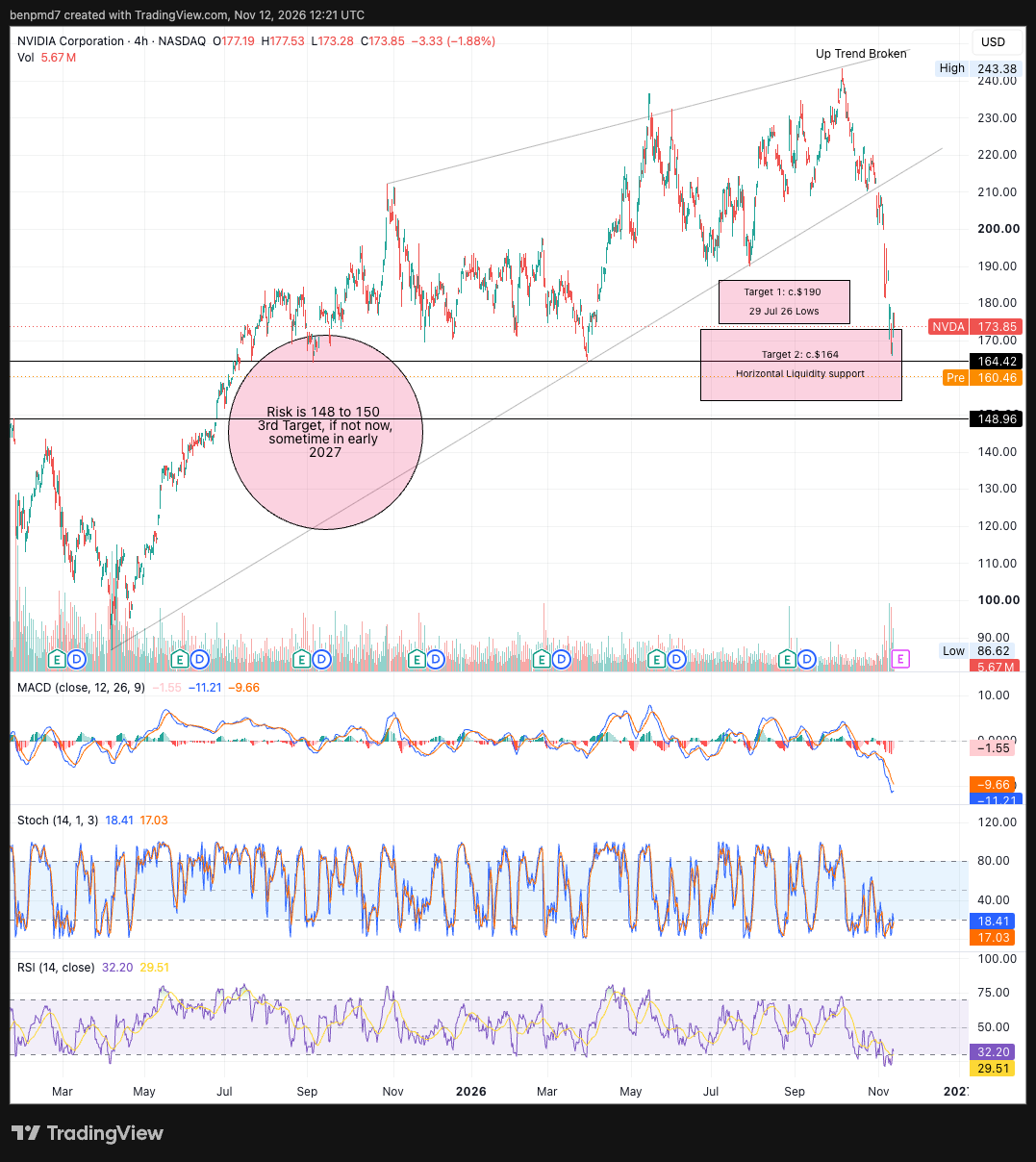
HindeSightTarget 2 at c. $164 is the level that matters now. The uptrend from the 2025 lows is broken and Target 1 at c. $190, the 29 Jul 2026 lows, gave way without a fight. Pre-market trade near $160 is already through $164, the horizontal liquidity support. The risk is $148 to $150, the third target, if not now then sometime in early 2027.
Source: TradingView, Hinde Capital. 12 Nov 2026.
Elevated put/call, a VXN ramp and heavy negative gamma did the rest. Dealer hedging turned a modest recovery into a self-reinforcing squeeze. The call not to buy the dip was wrong, and the residual shorts were squeezed out. There is no obligation to trade every move when structure overwhelms fundamentals.
Retail and leveraged ETFs helped fuel the bounce, so conditioned are they to buy the dip. They keep buying drawdowns of 5 to 10% from all-time highs as if we had witnessed a 40% correction. Retail can only buy so much at the highs before they become trapped sellers, along with the short gamma hedgers.
The grind ran to the gamma flip zone, c. 7621–47 on SPX and c. 28450–600 on NDX, and slowed there. Breadth remains poor. CoreWeave, the most hated AI name, ripped c. 24% on flattered earnings and an equity raise that questions its access to debt. A double or a zero.
Figure 9 · CRWV_D
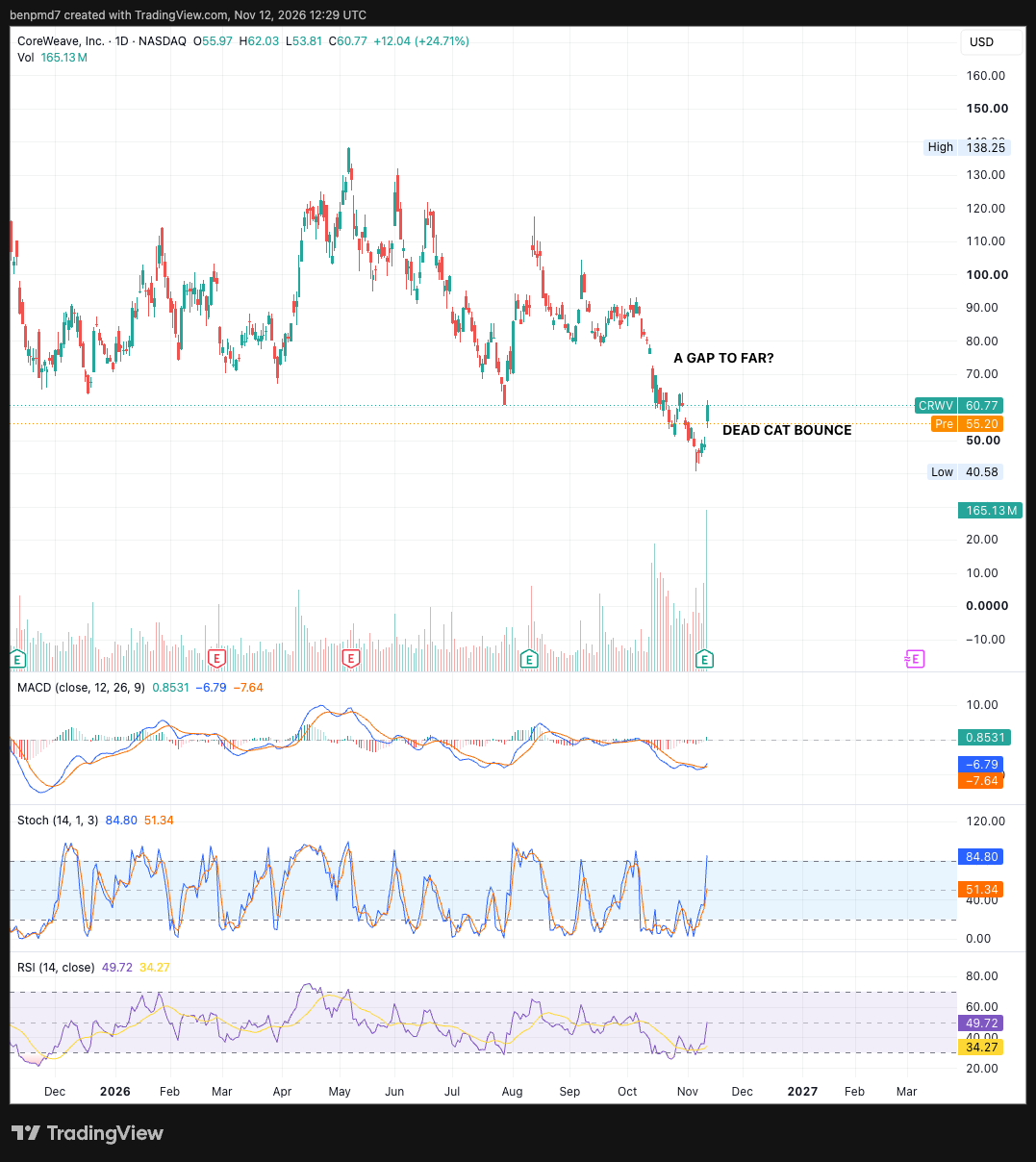
HindeSight$55 is the level that matters. CoreWeave gapped up 24.7% to close at $60.77 on 165m shares, the heaviest volume on the chart. Pre-market trade near $55 has already given back half the move. From a $138 high and a $40.58 low, this looks like a dead cat bounce, not a turn.
Source: TradingView, Hinde Capital. 12 Nov 2026.
The individual setups are where this gets decided. A lot of markets have rallied back to the scene of their technical breakdowns.
- TAIEX is back to the underside of major former support.
- KOSPI has filled its gaps after the intervention.
- SOXX and SMH have filled the first gap. Do they run to the higher breakaway gap?
- DRAM. SK Hynix, Micron and Samsung are ripping toward gap resistance.
- Mag7 is weak. Leadership is still unconvincing.
- Data centre and AI infrastructure (DCTR) are weak too, with very little energy in the bounce.
Figure 10 · SMH_4H
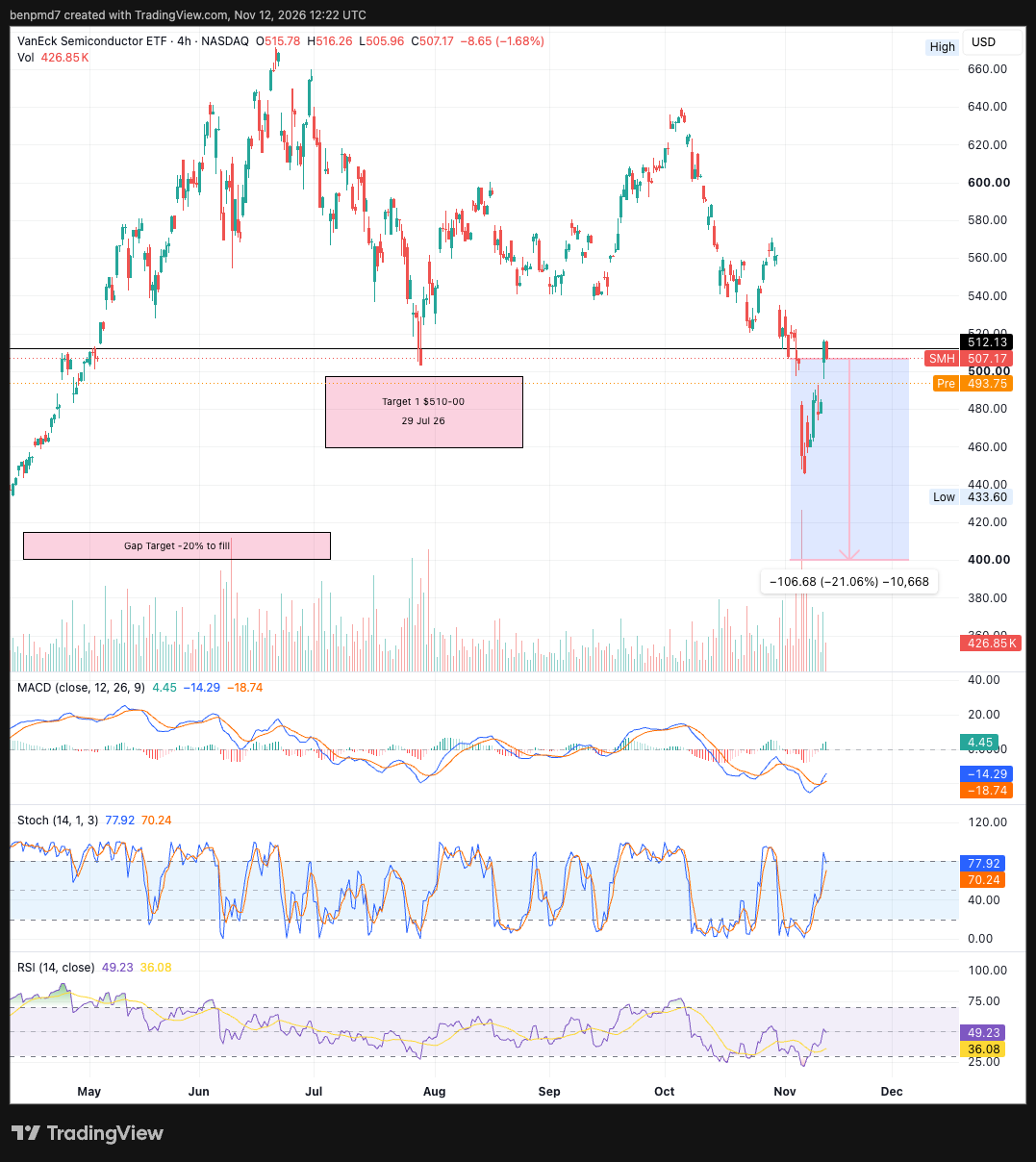
HindeSight$512 is the level that matters. SMH has rallied back to the underside of Target 1, the $510 to $500 zone from the 29 Jul 2026 lows, and pre-market trade near $494 is already slipping away from it. The recent low is $433.60. The gap target is c. $400, about 20% lower from here.
Source: TradingView, Hinde Capital. 12 Nov 2026.
Figure 11 · MAGS_D
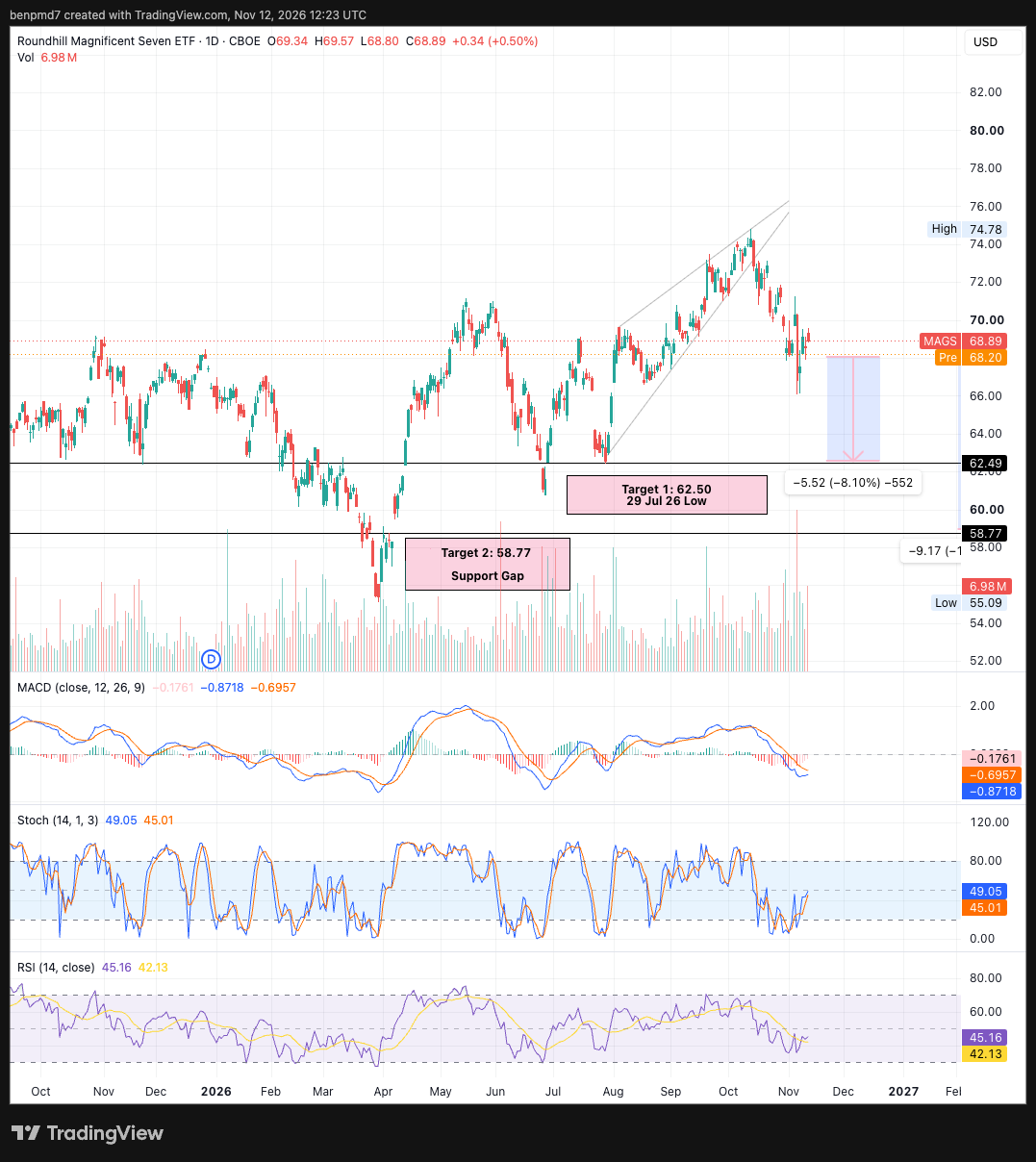
HindeSightTarget 1 at $62.50 is the level that matters, the 29 Jul 2026 low and about 8% below here. The rising wedge into the October high of $74.78 has broken. Below $62.50 sits Target 2 at $58.77, the support gap. Mag7 is weak and the leadership is still unconvincing.
Source: TradingView, Hinde Capital. 12 Nov 2026.
Figure 12 · TAIEX_D
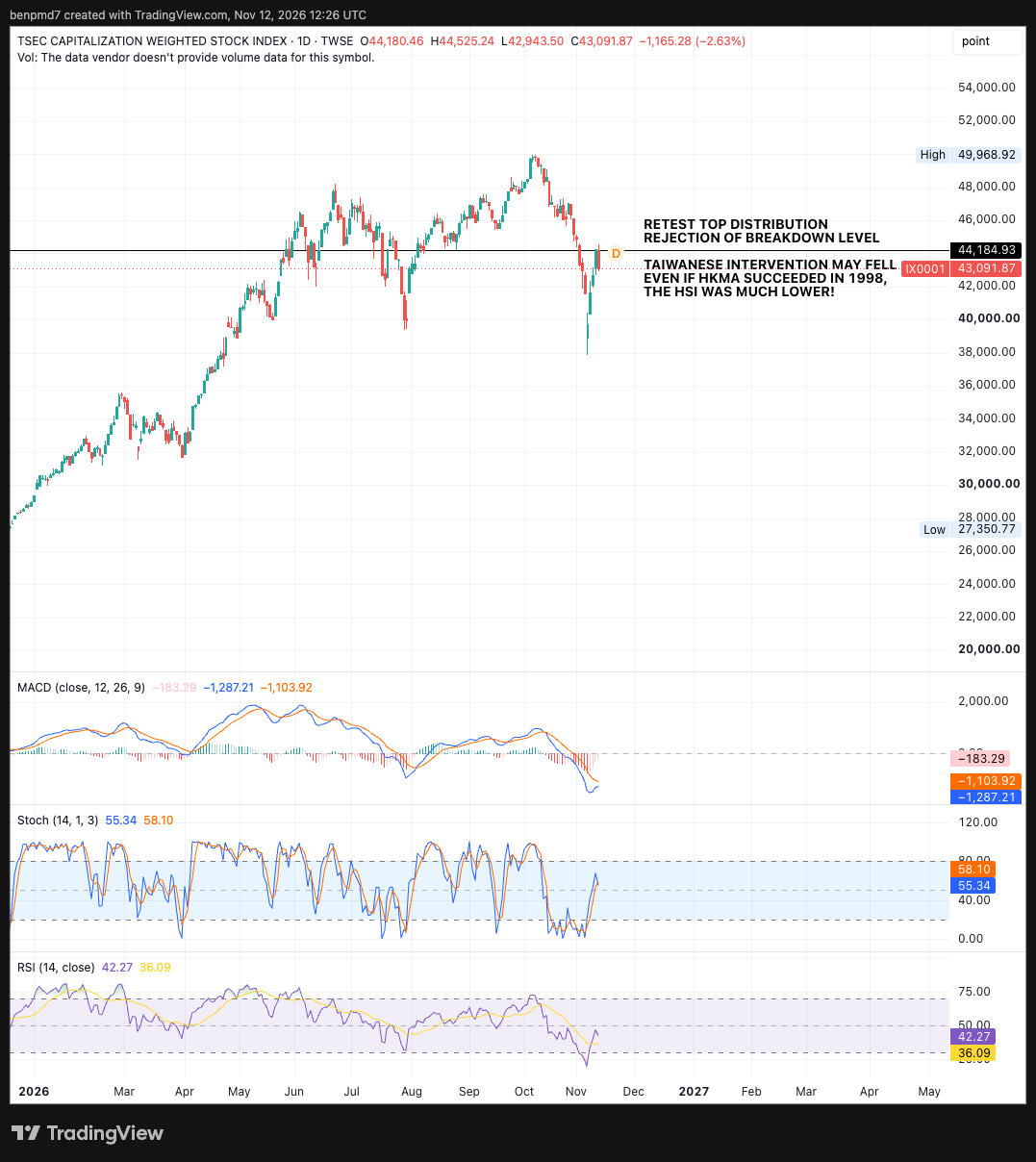
HindeSight44,185 is the level that matters. TAIEX has retested its top distribution and been rejected at the breakdown level, closing at 43,092, down 2.6% on the day. The Taiwanese intervention may fail. Even if the HKMA succeeded in 1998, the Hang Seng was much lower when it did.
Source: TradingView, Hinde Capital. 12 Nov 2026.
The larger disconnect is credit. Oil looks close to a major bottom, with diesel and cracks looking decent. Treasury yields are higher and AI and hyperscaler CDS and credit spreads are still widening, yet equities rally. Either equity risk is right or credit risk is right.
The major correction is not over. This bounce lacks breadth, leadership and credit confirmation, and the market needs to fail around these levels this week. SPX back above 7630 or NDX above 28400 risks another jam job. A break of 7455 and 27250 starts the next leg, with VIX and VXN rising across the curve.
The plan is to stay patient, protect gains and re-establish selective naked shorts, flipping some cheap AI longs along the way. The decline in the vol term structure is the cue to rebuild put barbells. Still long the dollar, having called for 103–105 with a maximum of 108 in September. The gold/silver ratio near 78 has my attention for a bullish divergent low in gold.
The right medium-term thesis is worth little without surviving the short-term path. And of course this could be completely wrong. As this is typed, Jensen is reportedly on his way out and the market is giving back its gains.
More From HindeSight
Sources
- 1The Economist, The Sorcerer of Silicon, 5 Sep 2026.
- 2Axios, Nvidia CEO Jensen Huang admits affair, board to launch investigation, 8 Nov 2026.
- 3CNBC, Nvidia investigates CEO Jensen Huang’s relationship with alleged Chinese spy, 8 Nov 2026.
- 4CNBC, Nvidia board meeting to decide CEO Jensen Huang’s fate stretches into evening, 11 Nov 2026.
- 5ABC News, Nvidia board reportedly preparing to oust CEO Jensen Huang after alleged affairs, 12 Nov 2026.
- 6France 24 with Reuters, Nvidia board weighs ouster of CEO Jensen Huang amid spy scandal, 12 Nov 2026.
- 7CBS News, Megaspeed’s vacant offices raise questions about ties to Nvidia and China, Nov 2026.
- 8CBS News, Nvidia short-seller warned in May of CEO Jensen Huang’s ties to suspected Chinese spy, Nov 2026.
- 9Yahoo Finance, This Short Seller Flagged Jensen Huang’s Ties to Alice Huang 6 Months Before Nvidia’s Scandal, Nov 2026.
- 10Bollwerk, Reading the Culper Research Short Report on NVIDIA, May 2026.
- 11Anthropic, PBC, Amendment No. 2 to Form S-1, 10 Nov 2026.
- 12Nasdaq, Nasdaq-100 Index Methodology, 2026.
- 13Wikipedia, Initial public offering of SpaceX, accessed 12 Nov 2026.
- 14Yahoo Finance, Nasdaq just put SpaceX stock investors on notice, Sep 2026.
- 15GuruFocus, Goldman Sachs Delivers Surprising Take on SpaceX Stock, 9 Nov 2026.
- 16StockAnalysis, Nasdaq 100 stocks list, QQQ holdings, 11 Nov 2026.